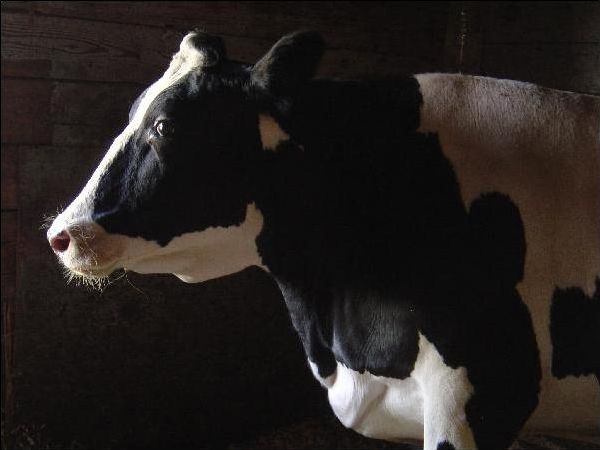
Jim and I received a call one day from the Peace Abbey asking if we could take in a rescued cow, our beautiful Cassie, who they rescued from a local slaughterhouse. She had jumped a six foot fence to escape death. Not anticipating any problems, we happily welcomed Cassie into our lives. On the day she arrived, the livestock trailer backed up to the barn door and we put up panels to guide Cassie into the barn and into her new stall. There was an open window in the barn that wasn’t far from the panels. In an instant, Cassie jumped over the panel and into the window, getting momentarily stuck half-way through. We eventually got her into her stall and she quickly turned around to face us. After the livestock trailer left, Jim’s first comment was that something wasn’t right with this cow. The longer I watched, the longer I realized that Cassie was petrified. Given what we knew about what she had been through, we could only imagine what had happened to her before she arrived at the slaughterhouse. We were confident that a little love, attention, good hay and time, Cassie would adjust and join our other cows.
Even though Cassie was showing signs of fear, we attempted to halter her to bring her outside about a week after her arrival. She spun her body around and tossed her head to not only avoid capture, but simply being touched. We found that she liked bread and used bite-size treats to gain her confidence with the halter and ultimately get her out with the other cows. Despite the presence of the cows, Cassie ran past them, through the thick brush and over stone walls. She was still terrified. It took Jim and I hours to capture her safely and lure her back to her stall. Over the next year we tried different techniques to get Cassie out of her stall and into a herd where we believed she should be. Each time was like the last, with Cassie running away from the other cows and barreling over and through every obstacle. When she broke into the hay fields, her fear seemed to intensify. One episode had her running full tilt across the field and approaching a small drainage ditch. Once she came to the ditch she took a terrible fall. Immediately getting back to her feet, she ran full tilt toward us. After more luring with treats, we caught her. I thought she was going to have a heart attack. Again, she was returned to her stall.
We talked to a few veterinarians and a few friends. Euthanasia was discussed. Jim and I struggled with this option. We were with Cassie everyday and into the nights. She was not an individual who wanted to die. She simply wanted to be inside and safe. It was during this thought process that we were put in touch with Dr. Dan Dodman and Dr. Linda Brightman from Tufts Veterinary School. Dr. Dodman is recognized worldwide for his knowledge of animal behavior and psychology. An appointment was arranged for both doctors to come and visit Cassie. After hours of discussion, examination and an attempt to sedate Cassie and get her to go outside, she was diagnosed with agoraphobia and possibly other anxiety disorders. The first thing we tried was putting Cassie on anti-depressants. This is sometimes used on dogs and cats but, to our knowledge, never on cows. In the meat and dairy production world, if a cow is dysfunctional or ill they are shipped to slaughter. Unfortunately, Cassie responded to the medication by becoming even more agitated and fearful. When this didn’t work, we then tried lightly sedating and “clicker” training her. Clicker training is used to train or change an animal’s behavior by reinforcing desired behaviors with the click and a treat, eventually eliminating the treat. The tasks were simple. We would touch Cassie on the nose and everyday work our touch further up her face, with the ultimate goal of being able to put the halter on. It would be a first step to begin another journey outside.
For weeks and weeks, I would progress slowly up Cassie’s face with a gentle touch. When it came time to introduce the halter, despite light sedation she became agitated. Even trying to open the window in her stall caused her overwhelming fear.
Another suggestion was to bring some cows into the barn with the hope that Cassie would bond with them and want to join the herd. So, that winter we brought three cows in to spend the whole winter in the comfort of the barn with Cassie. We allowed the cows free access to Cassie’s stall. We would feed the other cows and Cassie so that their heads would be together, they were close and so that they were able to smell one another. Spring came and we tried different techniques leading the cows out of the barn with the hope that Cassie would follow, or at least show a desire to join them. But, she wouldn’t budge. Her double stall was her sanctuary, her safe house. She displayed no interest in becoming part of the herd.
The longer we tried and failed with behavior modification, herd introduction, love and patience, we thought it best that Cassie be loved and cared for in an environment in which she felt safe. One recent improvement has been the reintroduction of her window. It took a few days but Cassie has accepted the open window and it is obvious to us that she enjoys the additional visual stimulation.
When it’s just Jim and I with Cassie, we’d leave her stall door wide open, hoping she’d make an attempt, on her own, to leave her stall. She’ll stand at the opening but will never cross the threshold. As of more than a year ago Cassie has started coming out of her stall and wandering in the area close to her stall. It is still in the barn but her area of comfort has increased and she seems to have an affection for the chickens that frequent her area! A human with an anxiety disorder is given medication and/or therapy. Cassie’s course of medication failed and the only therapy at the moment is love and support.
More recently I have had a wonderful conversation with Dr. Gay Bradshaw who has done extensive research with Post Traumatic Stress Syndrome in elephants, primates and parrots. Her initial assessment was that we were doing the right thing by following our hearts and being compassionate with Cassie. Like many people, animals may never recover from the trauma they experienced that damaged their psyche. Allowing them to live peaceful lives with love and understanding is often the best we can do. Forcing these animals to live up to our expectations of what we think will make them happy can often cause more misery to a gentle soul already wounded.
We have chosen a difficult and debated path of trying to give Cassie a life of peace and love, but we wouldn’t change a thing.
NOTE: Cassie was well loved and cherished by Jim & Cheri and passed away in 2016.